



%402x.svg)
Yves Saint Laurent: the man who revolutionized fashion and redefined feminine elegance
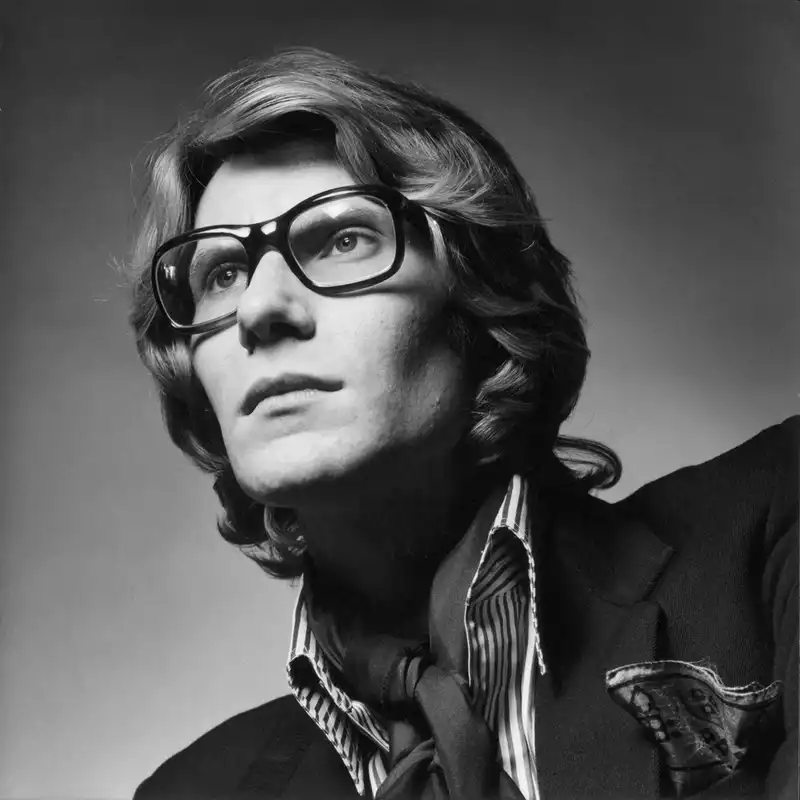
A name, a vision, a rupture
Born on August 1, 1936, in Oran, Yves Saint Laurent is one of the few creators who fundamentally transformed the way women dress, and what their clothes represent. More than a couturier, Saint Laurent was a mirror of his time, capturing the social, cultural, and political upheavals of the 20th century and translating them into silhouettes that would become legendary.
At just 21 years old, he became the youngest artistic director of the house of Christian Dior, propelled to the top after the sudden death of his mentor. A few years later, he founded his own fashion house with Pierre Bergé, laying the foundations of an aesthetic revolution whose influence is still felt today.
From origins to the Dior revelation
Born into a French family settled in Algeria, Yves Saint Laurent grew up in Oran, immersed early in drawing, theater, and imagination. Fragile, sensitive, and often out of step, he found in creation a form of refuge. His mother, Lucienne, encouraged this path and accompanied him to Paris, where he enrolled at the École de la Chambre Syndicale de la Couture Parisienne.
In 1955, spotted by Michel de Brunhoff (Vogue France), he was introduced to Christian Dior. Two years later, Dior’s death shattered the established order. Saint Laurent took over the house and presented the Trapèze collection in January 1958. The success was immediate and global. The press hailed a prodigious talent capable of lightening silhouettes, freeing the body, and modernizing couture.
But the pressure was immense. Drafted into military service, Yves Saint Laurent suffered a psychological breakdown. Hospitalized, he was dismissed from Dior in 1960. A painful rupture, but a defining one.
The birth of the Yves Saint Laurent house
In 1962, with the financial backing of patrons and the strategic support of Pierre Bergé, Yves Saint Laurent founded his own couture house. From the very first collections, a signature emerged: sharp lines, artistic references, the power of black, and a constant tension between masculine and feminine.
The year 1965 marked a turning point with the Mondrian dresses, a direct homage to abstract painting. Fashion became a cultural statement. It no longer simply dressed bodies, it engaged with art, music, and the street.
In 1966, Saint Laurent made history.
Le Smoking: when fashion became political
With Le Smoking, Yves Saint Laurent did not merely create a garment, he created a symbol. By translating the masculine tuxedo into the female wardrobe, he offered women a new posture: confidence, authority, controlled sensuality. The scandal was immediate. Some women were denied entry to restaurants for wearing trousers.
But history was already in motion.
The pantsuit, the safari jacket, the peacoat, the jumpsuit, sheer blouses, these pieces redefined femininity. At Saint Laurent, women were neither decorative nor constrained by imposed silhouettes. They chose. They asserted themselves. They existed.
Rive Gauche: luxury changes sides
In 1966, Yves Saint Laurent launched Saint Laurent Rive Gauche, the first ready-to-wear line signed by a major couturier. A cultural and economic revolution. Luxury left the private salons of haute couture and entered the street, youth culture, and everyday life.
The YSL logo, designed by Cassandre, became a universal graphic emblem. Boutiques opened in Paris, New York, and London. The Saint Laurent style spread, was adopted, and became iconic.
Fashion fueled by art and the world
Few designers have drawn as deeply from art as Yves Saint Laurent. Mondrian, Picasso, Matisse, Van Gogh, Braque, his collections were bold, deliberate tributes. Garments became canvases, fashion shows living exhibitions.
His travels, both real and imagined, deeply influenced his work. Morocco, discovered in 1966, was a revelation. Marrakech became a creative refuge and spiritual anchor. Colors, textures, and volumes from the East infused his imagination.
Japan, Russia, India, Africa, Spain, long before globalization became a buzzword, Saint Laurent was already weaving the world into his collections.
Muses and diversity ahead of their time
Yves Saint Laurent designed for real, free, singular women. His muses, Betty Catroux, Loulou de La Falaise, Catherine Deneuve, Victoire, Paloma Picasso — each embodied a form of independence.
He was also among the first designers to feature Black and Asian models on the runway at a time when diversity was virtually absent. Katoucha Niane, Iman, Rebecca Ayoko became emblematic faces of the house.
Excess, fragility, and the cost of genius
Behind the creative audacity lay a constant struggle. Depression, addiction, exhaustion, Yves Saint Laurent paid dearly for his hypersensitivity. The 1970s and 1980s oscillated between pure genius and self-destruction.
Yet the house flourished. Fragrances, cosmetics, and accessories ensured financial stability. In 1983, the Metropolitan Museum of Art in New York devoted a retrospective to him, the first time a living fashion designer received such an honor. Fashion officially entered the museum.
Legacy, transmission, and the end of a career
In 1999, the Yves Saint Laurent house joined the Gucci Group and later Kering. Several artistic directors succeeded one another in ready-to-wear, while Saint Laurent focused exclusively on haute couture.
In 2002, he announced the end of his career. A retrospective show at the Centre Pompidou retraced forty years of creation. The emotion was overwhelming. No successor would ever take over YSL haute couture.
Death and lasting influence
Yves Saint Laurent passed away on June 1, 2008, in Paris. His ashes rest in Marrakech, at the heart of the Majorelle Garden, which he had saved from ruin with Pierre Bergé.
His legacy is now preserved by the Pierre Bergé – Yves Saint Laurent Foundation and the museums in Paris and Marrakech. Over 5,000 haute couture garments, thousands of sketches, and archives testify to a monumental body of work.
Why Yves Saint Laurent remains essential
Yves Saint Laurent did not simply dress his era.
He gave women tools for emancipation.
He made fashion converse with art, politics, and the street.
He proved that clothing could be a language.
Even today, every tuxedo, every black suit, every androgynous silhouette bears the mark of his genius.
Saint Laurent is not nostalgia.
He is a living reference.
%401x.svg)
